Tag: less

  • My Values Underpinning This Website


    I’ve held the values that unpin this site my whole life, but I’ve not always been true to them.

    Part of the impetus for starting the site was a realisation that I’ve not been living true to those values. Particularly, in relation to the environment, the services I use, and the things I consume. It’s nothing but hypocritical to criticise companies like Amazon for their business practices, working conditions and impact on the environment and yet continue to use their services.

    I have written from the perspective that all people have equal intrinsic value as human beings”. Mike Berners-Lee

    I haven’t been standing up for the things I believe in, and that didn’t make me feel good about myself. It’s an uncomfortable realisation in your early 60s. But it’s not too late to make a change. It wasn’t as much a decision as an unavoidable evolution. After all, we all want to be able to look at ourselves in the mirror.

    It had never occurred to me to encapsulate that in writing until I read a section in the introduction to Mike Berners-Lee’s book, There is No Planet B. The section is titled, ‘What values underpin this book?’

    Mike has captured how I feel so accurately that it seemed foolish for me to rehash it. However, I don’t feel it would be fair to repost the whole section verbatim, so I’ve edited it to the parts that particularly struck a note with me. I urge you to read the book for yourself.

    Mike says, ‘I have written from the perspective that all people have equal intrinsic value as human beings. Rich, poor, black, white, American, European, African, Chinese, Syrian, Muslim, Buddhist, Christian, Atheist – everyone has the same intrinsic value.’

    ‘To be very clear, the same principle of inherent equal value of all human beings is universal. It applies to all world leaders, purveyors of both real and fake news, tireless aid workers, left wingers, right wingers, billionaires, paupers, your own kids, other people’s kids and even the call centre employee who rings you when you are having dinner with your family to try to persuade you to sue for an accident that never even happened.’

    ‘It means that while you might want good things for your own country, you don’t want that at the expense of other countries. If you want your country to be ‘great’ or even ‘great again’, you would be careful not to go about engineering that at the expense of any other country’s ‘greatness’.

    ‘It means that, when you go shopping, what you buy is not just the product itself but also a whole set of implications for everyone who was involved in producing it. This is the hidden stuff, almost entirely ignored by the advertising industry, which we need to find a way of tuning in to.’

    I’d highly recommend ‘There is No Planet B: A Handbook for the Make or Break Years’ by Mike Berners-Lee (I have the updated edition). I originally borrowed it from the library, but it’s such an incredible resource, I’ve since ordered a copy.

    Please don’t order from Amazon. There is a range of alternatives on the website.

  • Little Miss Giggles and 70,000 tonnes of Plastic


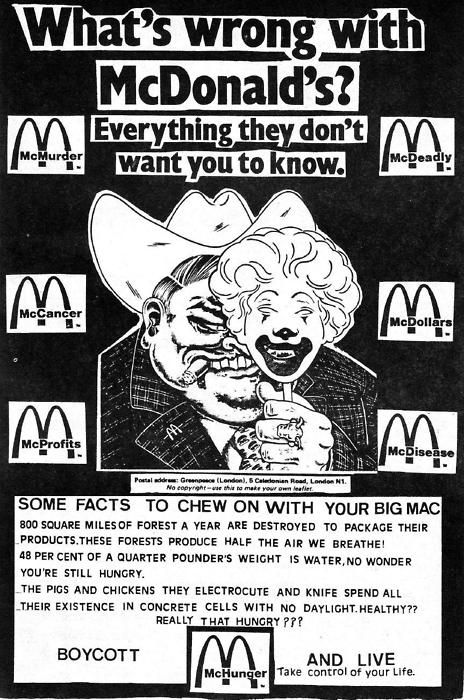
    I’ve been listening to the excellent BBC podcast The People vs McDonald’s presented by Mark Steele, retelling the story of the McLibel case. In the 1990s, the McDonald’s Corporation sued two members of London Greenpeace over claims made in a leaflet they were handing out to the public in a London street.

    Before the trial, leaflets were being given out on a north London street, to a couple of hundred people on the average Saturday afternoon. After McDonald’s incredible own goal, which became the longest legal trial in British legal history, costing McDonald’s millions of dollars, the health, and environmental issues associated with fast food came to worldwide attention – great work McDonald’s!

    Fast forward to 2021: The children at the next table in the Food Court already have the toys they got with their Happy Meals, so, disappointed, they leave them sitting in a pile of half-eaten chips and waste packing.

    They’re undoubtedly cute in their own way. However, Little Miss Giggles here is 63 grams of non-recyclable plastic. Mr Tickle is a little lighter at 58 grams. McDonald’s own figures state that between 2018 and 2022 (a period that included the global pandemic, when many restaurants were closed), worldwide sales of Happy Meals exceeded 5.7 billion. An average of 1.14 billion plastic toys a year.


    Not all Happy Meal toys are equal, but if they all weighed as much as Little Miss Giggles, that’s 71,190 tonnes of non-recyclable plastic per year. How many of those end up in the bin before they’re a day old? That’s seventy-one thousand, one hundred and ninety tonnes of plastic that will still exist long after those children have passed away. In fact, Little Miss Giggles will likely be indistinguishable from that photo in a thousand years.

    Global plastic production increases year on year. In 2023 (the latest date I could find reliable figures), the world produced 413.8 million tonnes of plastic, of which 91.3% was fossil-based (oil basically).

    Earlier this year, an article in Nature Magazine stated that a researcher at the University of New Mexico in Albuquerque “estimates that he can isolate about 10 grams of plastics from a donated human brain. That’s about the weight of an unused crayon”. There is nowhere they have not reached; microplastics have recently been found in the placentas of premature children..

    Could it be time to accept that the world only needs a certain number of plastic toys? I hate to sound like your stressed parent at Christmas, but can’t we just play with the billions of plastic toys we already have?

    Stay safe out there. N.

    BTW. If you’re interested in the McLibel campaign I’d recommend the documentary mentioned in the podcast made by Franny Armstrong of Spanner Films.

  • Moving Away From Big Tech

    Recently, I realised how much I was spending each month on the online services that have accumulated over time. I’ve always been interested in tech, so maybe, I was spending more than most, I don’t know, but it was definitely getting out of hand.

    The process of looking at what services I was paying for made me realise quite how much of my data is held in the servers of mega-corporations, many of which are outside the EU’s tighter privacy regulations. Something I wanted to change.

    I hope to be able to retire at some point in the next few years so reducing my monthly outgoings seems like a sensible move, before my income drops.

    I’m going to update this post as I make changes.

    The services I was using at the start of 2025

    • 1password: Password manager service
    • Apple Photos: iPhone storage
    • Backblaze: Online backup
    • Capture One: photo organisation/storage
      I love Capture One, but it’s expensive and I’m not doing any serious photography, so it may need to go. I’m playing around with Darktable, but it seems very clunky in comparison.
    • Evernote: Note-taking app.
      I’ve been paying for EN since 2008, but in the last couple of years it’s become bloated and laden with bugs. I’ve also never been that comfortable with my data being saved in a basically inaccessible proprietary format.
    • Google Calendar
    • Google Drive
    • Gmail: Technically free, but not really.
    • Grammarly: Grammar editor
      The use of Grammarly gives away the poor state of my written English. I was using Grammarly for writing associated with documentary work.
    • Lebara: Mobile phone service
      Good and affordable, no complaints
    • Squarespace: Website
      Great, but expensive.
    • Todoist: To-do list manager
      I mainly use Todoist for work. It’s excellent, but unnecessary for my home needs. As soon as I get to retire, I look forward to not needing it!

    In total, that was costing about £600 / year (some services are charged in Dollars, so the cost changes). In addition, between us my wife and I are paying for Broadband, Netflix, and Channel 4+. That all adds up to a fair chunk of change.

    The biggest change was going to be moving away Gmail where my email has sat for at least 20 years, probably more. I didn’t want to move it more than once, so I’ve taken some time looking at the options. I finally settled on Posteo, (based in Germany) I’ll explain why in a separate post, but they seem a balance between security, privacy, and price. I’m now going through the tedious task of moving my, seemingly, 100’s of accounts and subscriptions from Gmail to Posteo.

    Where I am in: November 2025

    • 1password ($72.00 / year)
      We are both so embedded with 1password I can’t think of moving at the moment.
    • Apple Photos storage ($0.99/month)
      I’d like to find an alternative, but Apple storage is only 99 cents / month. I can only think finding a service that’ll work on the iPhone is going to be janky to implement.
    • Backblaze ($118.80 / year)
      I’m really conflicted about Backblaze. There’s no doubt that a self-managed off-site backup is a good idea, but is it really necessary for me to have all my data on a server (or probably two), using power and water? Probably not. I’m thinking of buying a couple of big ole disks and keeping one off site.
    • darktable (free)
      An open-source, Lightroom/Capture One alternative. I’m very new to it, it’s fine. There’s a steep learning curve and it’s not pretty.
      Update: I’m still playing with Darktable, but boy, it’s not easy. My licence for Capture One doesn’t expire until early 2026, so I’ve still been using it when I need to edit an image quickly.
    • Obsidian (free)
      An open-source note-taking app, using simple Markdown files, which sync through iCloud. If I move away from iCloud, I’d need to find an alternative sync service, which is where Apple hold all the cards. Syncing to and from the iPhone is not straightforward.
    • Obsidian Publish ($96/year)
      Used to publish this site. A paid add-on to Obsidian. It’s far from sophisticated, basically a folder of markdown files, but I like it for that; it feels a little expensive compared to the competition.
    • LibreOffice (free)
      An open-source office suite: an amazingly accomplished free alternative to Microsoft Office (without the annoying AI). As a test, I’ve been using it in a professional environment for a couple of years and no one is any the wiser.
    • Posteo (€12 / year)
      Email and calendar. All good so far.
    • Google Drive($15.00 / year)
      I’m looking for alternatives. If you have suggestions, let me know.
    • Lebara
      Mobile phone and data. I’ve no plans to change.
    • TickTick (free-version)
      To-do list. I’m using this, combined with a pocket notebook, for my personal to-dos. I’ll stop paying for Todoist when I stop work.

    The current total is about £285 / month (with two exchange rates to take into account, the exact figure is constantly changing), less than half I was paying at the start of the year. Squarespace and Grammarly are the two biggest savings. Backblaze is the largest potential saving, but I’m aware if were to lose any data, $119 would seem a small price to pay to get it back.

    If you have any thoughts or recommendations, let me know.

    (Profound apologies to Lester Beall for ripping off another of his amazing designs.)